


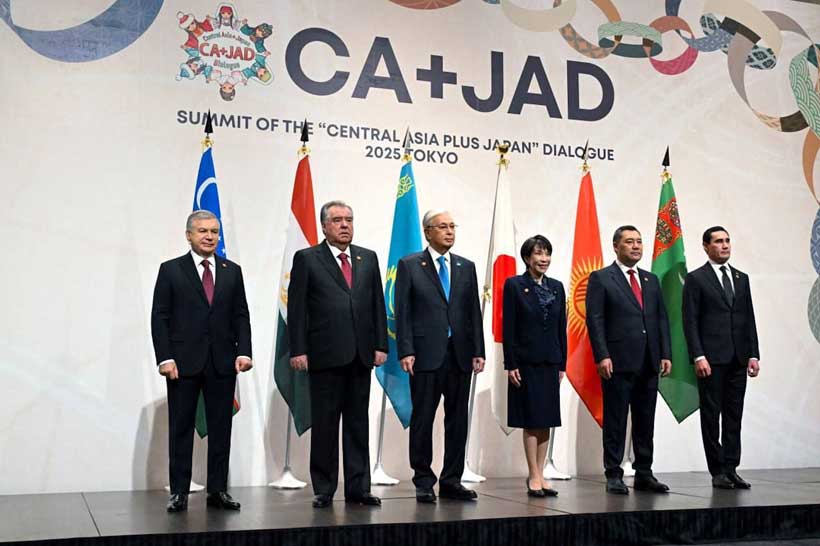
On December 20, 2025, Japan and the five Central Asian nations (Kazakhstan, Kyrgyzstan, Tajikistan, Turkmenistan, and Uzbekistan) convened the Central Asia plus Japan Dialogue (CA+JAD) in Tokyo. This marks a significant institutional milestone. For the first time since Japan launched the mechanism in 2004, the framework has been elevated from the ministerial level to a full heads-of-state summit. The meeting resulted in the adoption of the “Tokyo Declaration” and the launch of the “Tokyo Initiative”, establishing a cooperation framework centered on green development, regional connectivity, and human resource training. Underpinning these diplomatic gestures is a concrete target to implement commercial projects totaling approximately JPY 3 trillion over the next five years, with a substantial number of financing arrangements finalized during the summit and the concurrent business forum.
Japan’s comprehensive strategy toward Central Asia now exhibits a systematic structure defined by institutional upgrading, initiative-led guidance, project-based support, and financial coordination. However, from a structural perspective, the scale of this cooperation and the existing geographical constraints mean that Japan is not yet in a position to fundamentally challenge China’s established economic and security influence. Nevertheless, because this new phase moves beyond symbolic dialogue into critical sectors, such as strategic minerals, logistics corridors, and financial instruments, it introduces significant structural shifts and long-term spillover effects that warrant close attention.
The first major impact lies in the realignment of critical resource supply chains. Japan has placed the strengthening of mineral security at the strategic core of this framework, explicitly advancing the exploration, processing, and long-term supply of uranium, rare metals, and gallium. The intent is clear: against a backdrop of persistent tensions in Japan-China relations and rising uncertainty over export controls, Tokyo is seeking a procurement channel independent of Beijing to mitigate the risk of structural dependency. By leveraging government agencies and major sōgō shōsha (general trading companies), Japan is already pushing rare metal exploration in Kazakhstan and has initiated its first imports of semiconductor materials from the region. These moves, led by entities such as JOGMEC, Itochu, and Mitsui, directly target sectors where China has long held global dominance, potentially weakening China’s marginal bargaining power.
Furthermore, Japan’s emphasis on “full-chain cooperation”, spanning everything from exploration to logistics and financial backing, encourages Central Asian nations to diversify their partner portfolios. In the medium-to-long term, this could increase the competitive intensity and institutional friction China faces when securing these resources. While resource development in Central Asia remains heavily reliant on infrastructure systems currently dominated by Chinese and Russian technology and capital, Japan’s strategy acts as a “supplementary positioning” that provides regional states with an alternative. This functions more as an external constraint on China and a diversification of risk rather than a sudden restructuring of the global landscape.
Stay ahead of the geopolitical week.
MD Briefing delivers expert analysis across five global fronts — the Indo-Pacific, energy, geoeconomics, European security, and the Middle East — every Monday morning. Free.
Regarding regional connectivity, Japan has explicitly backed the “Middle Corridor,” or the Trans-Caspian International Transport Route, which connects to Europe via the Caspian Sea. By utilizing Official Development Assistance (ODA) to upgrade customs equipment and digital solutions, Tokyo is promoting Eurasian logistics routes that bypass Russia. This objective aligns with the broader Western narrative of “de-risking” and creates a potential diversionary relationship with the China-led China-Europe Railway Express. If this infrastructure continues to improve, cargo flows sensitive to lead times and political risks may shift toward these diversified options, marginally affecting China’s relative dominance over regional logistics hubs and international rule-setting.
On a financial level, Japan has significantly strengthened the coordinated application of policy finance and development assistance. Key players like the Japan Bank for International Cooperation (JBIC) and JICA are entering the market simultaneously, advancing billions of dollars in financing for Kazakhstan and Uzbekistan. By establishing intergovernmental committees and exploring Special Economic Zones (SEZs) for Japanese investors, Tokyo is attempting to elevate bilateral cooperation from the project level to the institutional level. This approach uses financial tools as a catalyst to increase Japan’s visibility and agenda-setting power within Central Asian policy circles, potentially squeezing the institutional space available to China in specific niche areas.
Despite these advancements, Japan’s influence remains concentrated compared to the multi-layered structure of trade, infrastructure, and security cooperation that China has already established. Japan’s engagement focuses primarily on financial support and flagship demonstration projects, lacking the broad industrial hinterland and large-scale market absorption that China provides. Consequently, Japan’s impact is likely to manifest as “point-based reinforcement” rather than a systemic expansion across the entire region.
Geopolitically, Japan intends to embed its Central Asian policy within a broader Western strategic framework by emphasizing a “free and open international order based on the rule of law”. This aligns Tokyo closely with U.S. and European interests in a region where Chinese and Russian influence heavily intersect. While these actions increase the complexity of major-power dynamics and introduce more external variables into regional affairs, the five Central Asian nations can be expected to adhere to “multi-vector” diplomacy. Their core priorities of economic development and risk diversification mean they lack the incentive to pivot entirely toward any single power. For these states, Japan is a tool to increase their bargaining chips rather than a strategic patron intended to fully replace China or Russia.
Ultimately, the upgrading of the Japan-Central Asia cooperation mechanism does not represent a direct, single-dimensional blow to China’s regional influence. Instead, it constitutes a structural disturbance formed by the convergence of multiple marginal channels. It expands the room for maneuver for Central Asian nations without yet shaking the deep economic integration and systemic advantages China has built over decades. That being said, it will increase the complexity and coordination costs for China as it advances its regional agenda.
